
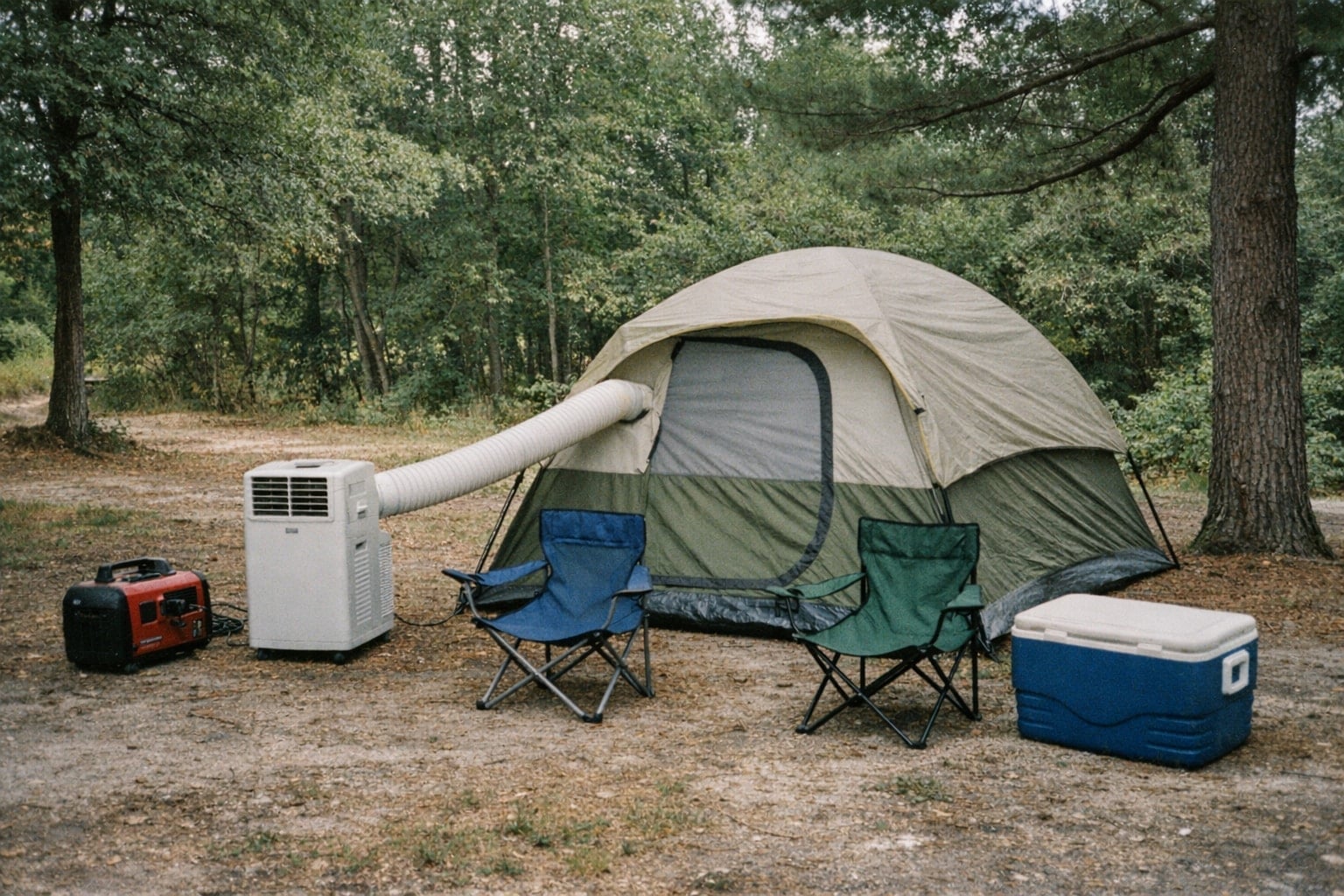
Sleeping in a hot tent is miserable. Temperatures inside a tent can exceed outdoor temps by 10-20°F, and without airflow, falling asleep becomes nearly impossible. A tent air conditioner fixes that.
Well, good news! You actually can have a tent air conditioner — a portable AC for camping — and we can help you choose the one that’s right for you! This guide covers the five best tent air conditioners for 2026, broken down by cooling type, power source, and tent size, so you can pick the right unit for your setup.
Without further ado, let’s jump in!
Related: Summer Camping in Hot Weather? Here are 26 Tips to Stay Cool
Best Tent Air Conditioners: Top Portable AC for Camping Picks
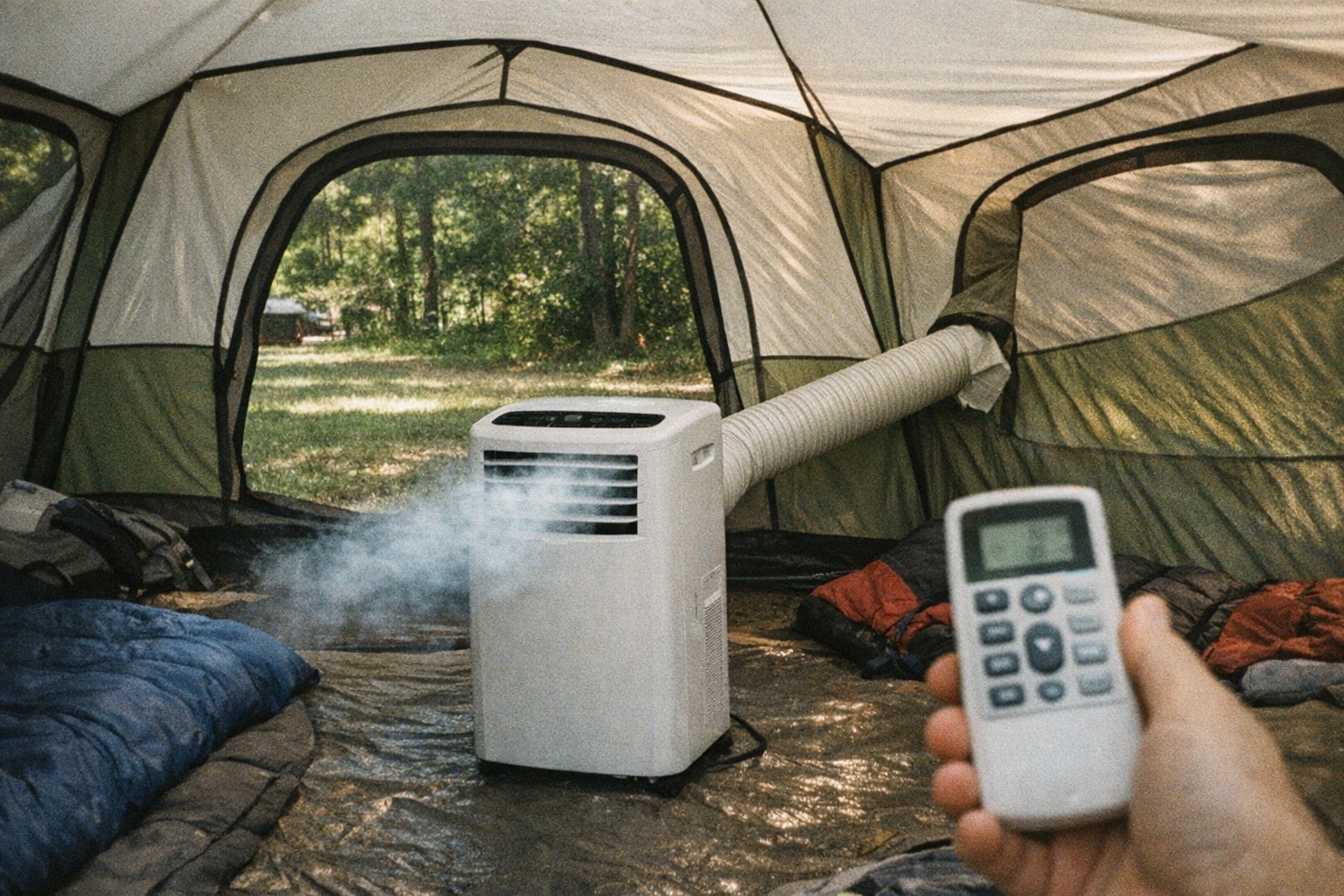
⚡ Power Source Warning: Before you buy, know this: traditional portable air conditioners (like the hOmeLabs and Frigidaire below) require a 110V shore power hookup — they will not run on a standard battery or car outlet. Evaporative coolers and battery-powered units (like the IcyBreeze and Evapolar) do not need shore power and are the right choice for primitive campsites or dispersed camping. Choosing the wrong type is the most common tent AC buying mistake.
How to Choose a Tent Air Conditioner
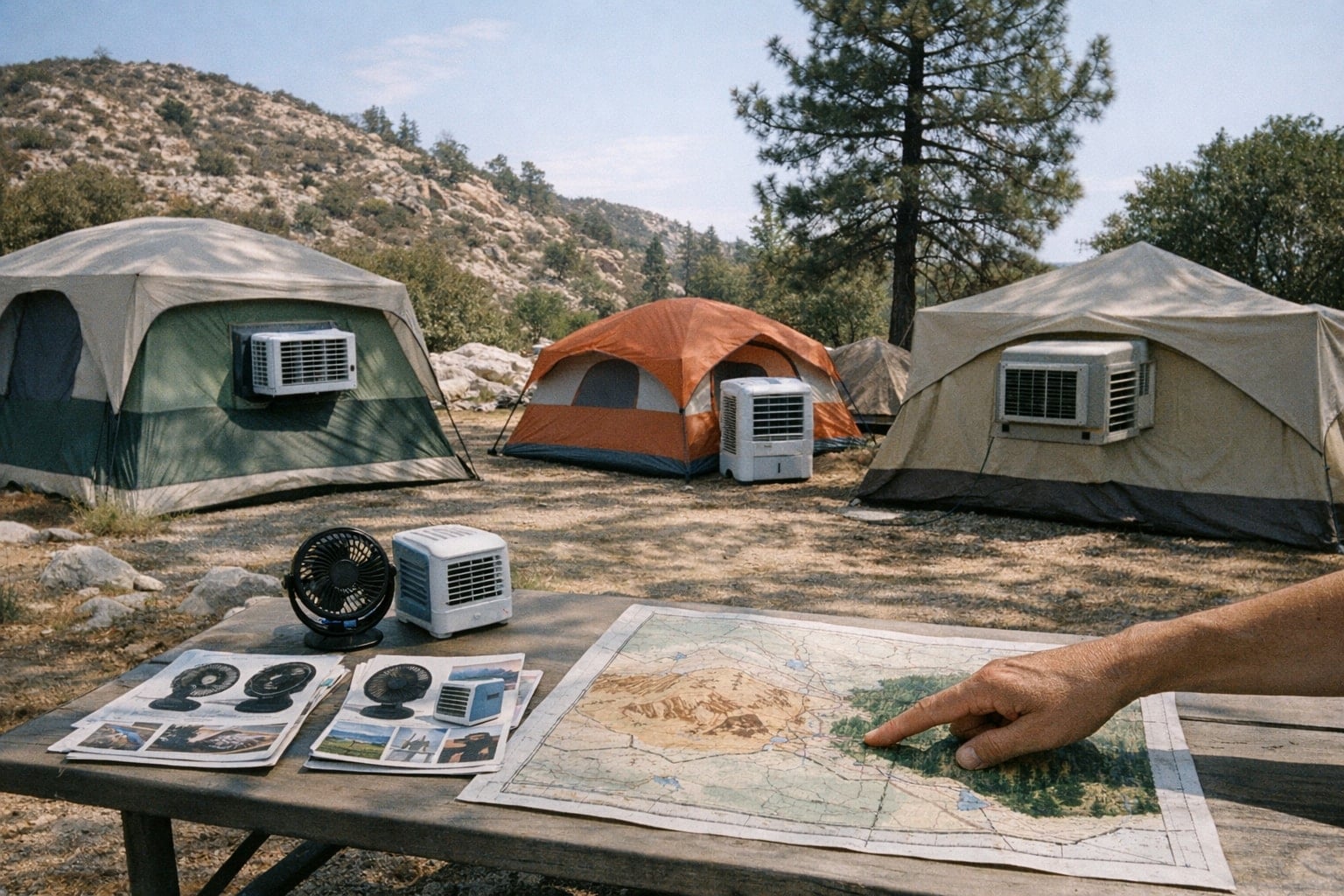
Not all camping air conditioners are created equal. Here’s what to consider before you buy the best AC for tent camping that fits your situation.
BTU vs. Tent Size: How Much Cooling Power Do You Need?
BTU (British Thermal Units) measures how much heat an air conditioner can remove per hour. As a general rule of thumb for tent camping: allow roughly 20 BTU per square foot of tent floor space. A small 2-person tent (~50 sq. ft.) can be cooled by a 1,000–2,000 BTU unit, while a large family cabin tent (~200 sq. ft.) needs at least 5,000 BTU. For evaporative coolers, look at CFM (cubic feet per minute) airflow instead — higher CFM means more air moved and a larger effective cooling area.
Power Source Options: Shore Power vs. Battery vs. Generator
Your campsite’s power situation is the single most important factor in choosing a portable AC for camping:
Shore power (110V hookup): Required for traditional portable ACs and window units. Available at most developed campgrounds with electric sites.
Generator: Can power a traditional AC but adds noise, weight, and fuel cost. Check campground generator hours before relying on this.
12V rechargeable battery: Powers units like the IcyBreeze. Ideal for primitive sites with no hookups. Runtime is limited, so bring spare batteries.
USB power: Powers small personal coolers like the Evapolar evaCHILL. Can run from a power bank, making it the most off-grid-friendly option.
Humidity Considerations: AC vs. Evaporative Cooler
This is a critical distinction. Traditional air conditioners remove humidity from the air — great for humid climates in the Southeast or Pacific Northwest. Evaporative coolers add moisture to the air as they cool it. In a dry climate like the American Southwest, that added humidity feels refreshing. In an already-humid environment, an evaporative cooler will make your tent feel muggy and uncomfortable. Match the technology to your climate.
Weight and Portability Trade-offs
The more powerful the cooling, generally the heavier the unit. The hOmeLabs portable AC weighs 70 lbs — fine for a car camping trip where you drive to your site, but impractical for anything involving a hike. Evaporative coolers and personal coolers are significantly lighter and more packable. Always consider how far you’ll carry your gear from the car to the campsite before choosing a unit.
hOmeLabs 14,000 BTU Portable Air Conditioner — verify availability on Amazon
Frigidaire 5,000 BTU Window-Mounted Room Air Conditioner — verify availability on Amazon
Honeywell 525 CFM Indoor Outdoor Portable Evaporative Cooler — verify availability on Amazon
IcyBreeze Portable Air Conditioner & Cooler — verify availability on Amazon
Evapolar evaCHILL Personal Evaporative Air Cooler — verify availability on Amazon
Tent Air Conditioner Comparison Table
Product | Type | BTU / CFM | Coverage Area | Power Source | Best For |
|---|---|---|---|---|---|
hOmeLabs 14,000 BTU | Portable AC | 14,000 BTU | Up to 700 sq. ft. | 110V shore power | Large family tents with electric hookup |
Frigidaire 5,000 BTU | Window AC | 5,000 BTU | Up to 150 sq. ft. | 110V shore power | Tents with AC window ports, humid climates |
Honeywell 525 CFM | Evaporative cooler | 525 CFM | Medium–large tents | 110V shore power | Dry climates (Southwest), no exhaust hose needed |
IcyBreeze Cooler-Hybrid | Cooler-hybrid | N/A (ice-based) | Personal / small tent | 12V rechargeable battery | Off-grid camping, minimizing gear |
Evapolar evaCHILL | Evaporative cooler | N/A (personal) | 45 sq. ft. | USB (power bank compatible) | Solo campers, budget buyers, dry climates |
1. hOmeLabs 14,000 BTU Portable AC for Camping
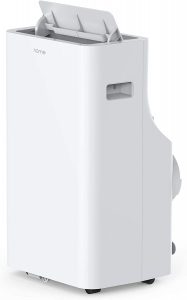
Featuring an oscillating cool-air outlet, multiple modes, and a timer, all of which are controllable via the touch panel or remote control, the hOmeLabs 14,000 BTU Portable Air Conditioner is our overall top pick for the best tent air conditioner.
The hOmeLabs Portable Air Conditioner is our top pick for family tents, with enough power to cool spaces up to 700 sq. ft. Thanks to the 14,000-BTU capacity, the hOmeLabs portable AC has enough cooling power for up to 700 sq. ft. A wide-set air-distribution panel swings up and down, directing cool air across the full tent interior.
You can set this portable AC unit anywhere from 62 to 86 degrees Fahrenheit. Alternatively, the unit can be set to “auto mode” which allows the AC to select the best temperature. And if all you want is a cool breeze, the dual-speed fan can be activated.
It also has a built-in dehumidifier with impressive coverage of 5,500 sq. ft. In fact, the unit is capable of removing 100 pints of moisture from the air per day.
At 70 lbs, the hOmeLabs is heavy, but four wheels and two integrated side handles mean you roll it rather than carry it.
Note: Please verify this product is currently available on Amazon before purchasing, as listings and model numbers may have changed.
2. Frigidaire 5,000 BTU Window-Mounted Camping Air Conditioner
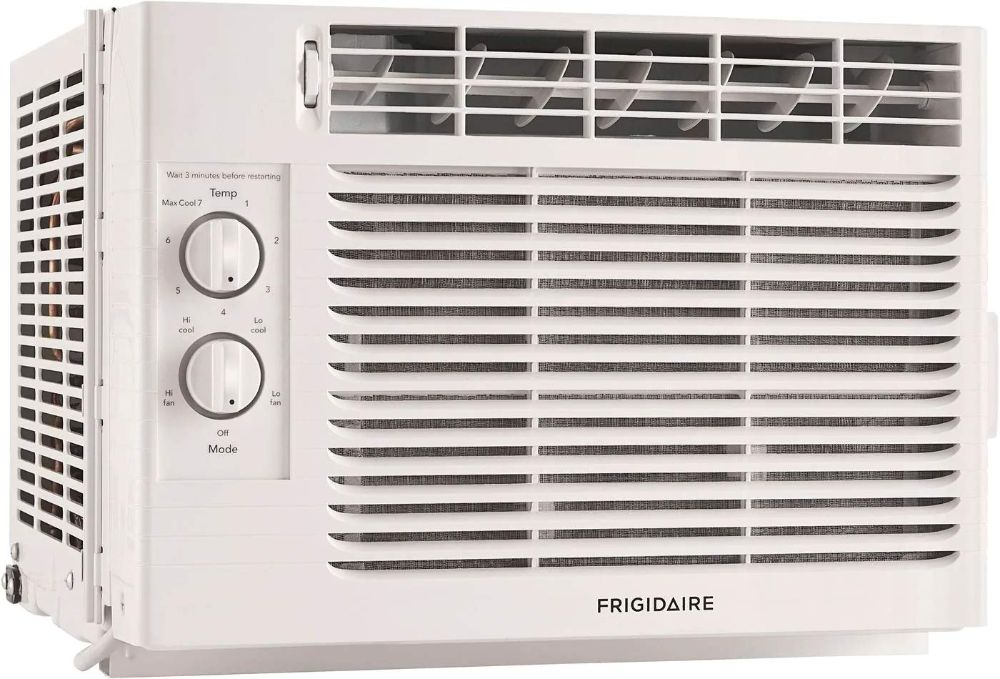
Window AC units are another popular choice for cooling tents, especially larger tents. Some tents even have ports for setting up your window unit, but you can use them with just about any tent.
Our top window AC pick is the Frigidaire 5,000 BTU Window-Mounted Room Air Conditioner. It has seven different temperature settings, plus a quick cool/warm mode to add an extra punch of speed to temperature adjustments.
It’s able to cool up to 150 square feet and is able to dehumidify as well, pulling 1.6 pints of water out of the air each hour. Say goodbye to a muggy tent interior on hot days!
The AC unit uses washable filters for convenience. The 72-inch power cord reaches most campsite hookups without an extension cord. And if you ever lose power for any reason, Effortless Restart means that the AC will go right back to the previous settings when power is restored.
This AC is covered by a one year warranty.
Note: Please verify this product is currently available on Amazon before purchasing, as listings and model numbers may have changed.
3. Honeywell 525 CFM Portable AC for Camping (Evaporative Cooler)
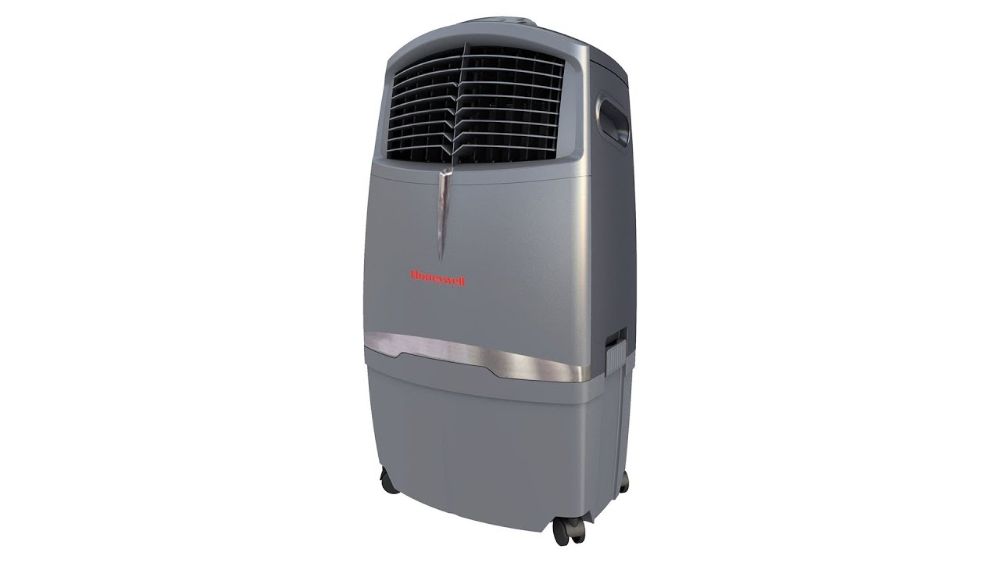
The Honeywell 525 CFM works differently from the first two picks: it adds moisture to the air rather than removing it, which makes it effective in low-humidity regions like the American Southwest.
The Honeywell 525 CFM Indoor Outdoor Portable Evaporative Cooler is, as the name states, an evaporative cooler. That means it pulls in warm air and uses water evaporation to cool it. Then a powerful 525 CFM airflow fan spits out the cold air (with some of that evaporated moisture) to cool your tent. Think the cooling effect of fresh air that’s just blown across a lake.
Unlike traditional air conditioners, there’s no hot air output, so there’s no need for annoying exhaust hoses. You just have to make sure that the water tank doesn’t empty. You can also fill the additional ice compartment for even faster cooling.
A low water alarm gives you a heads up when the water tank needs to be refilled without having to look at the LED display. The included remote control allows you to use all the evaporative cooler’s functions without having to get up, including choosing from the four fan speeds and setting the auto-timer.
Note: Please verify this product is currently available on Amazon before purchasing, as listings and model numbers may have changed.
4. IcyBreeze Portable Air Conditioner & Cooler
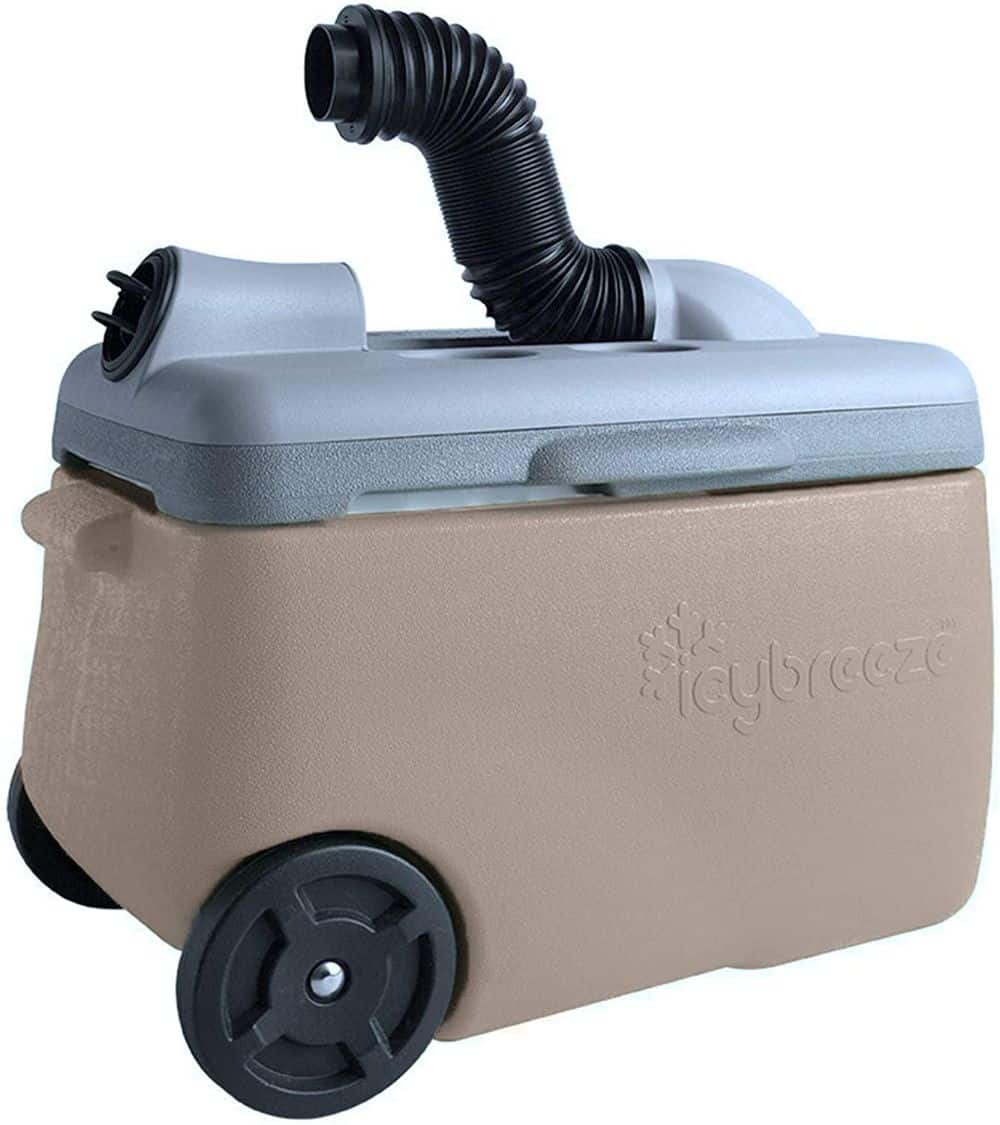
The IcyBreeze doubles as a standard camping cooler, using the cold meltwater at the bottom to chill the air it blows out. You know that cold water that pools at the bottom of your cooler as ice melts? The IcyBreeze Portable Air Conditioner & Cooler uses that water to cool down air the same way our last pick does.
Since cold water isn’t building up so much in the bottom of the cooler, it’s not causing your ice to melt faster, which is handy since while the ice is waiting to melt, you can use it to keep your food and drinks cold just like you would in a regular camping cooler. All in all, the IcyBreeze has a 38 quart volume.
For campers who want to reduce gear, the IcyBreeze replaces both a cooler and an AC unit in one 38-quart package. It runs on a 12-volt rechargeable battery, so it works at sites without power hookups.
A battery and charger are both included with the cooler, but you may want to pick up a spare or two so you can continue to run the AC while the previous battery charges. IcyBreeze also sells a number of other useful accessories, like power supplies, an airflow splitter for dual hose setups, extension tubes, and a corded remote.
Just like a regular cooler, this one has large wheels and a handle to help with portability.
Note: Please verify this product is currently available on Amazon before purchasing, as listings and model numbers may have changed.
5. Evapolar evaCHILL Personal Evaporative Air Cooler
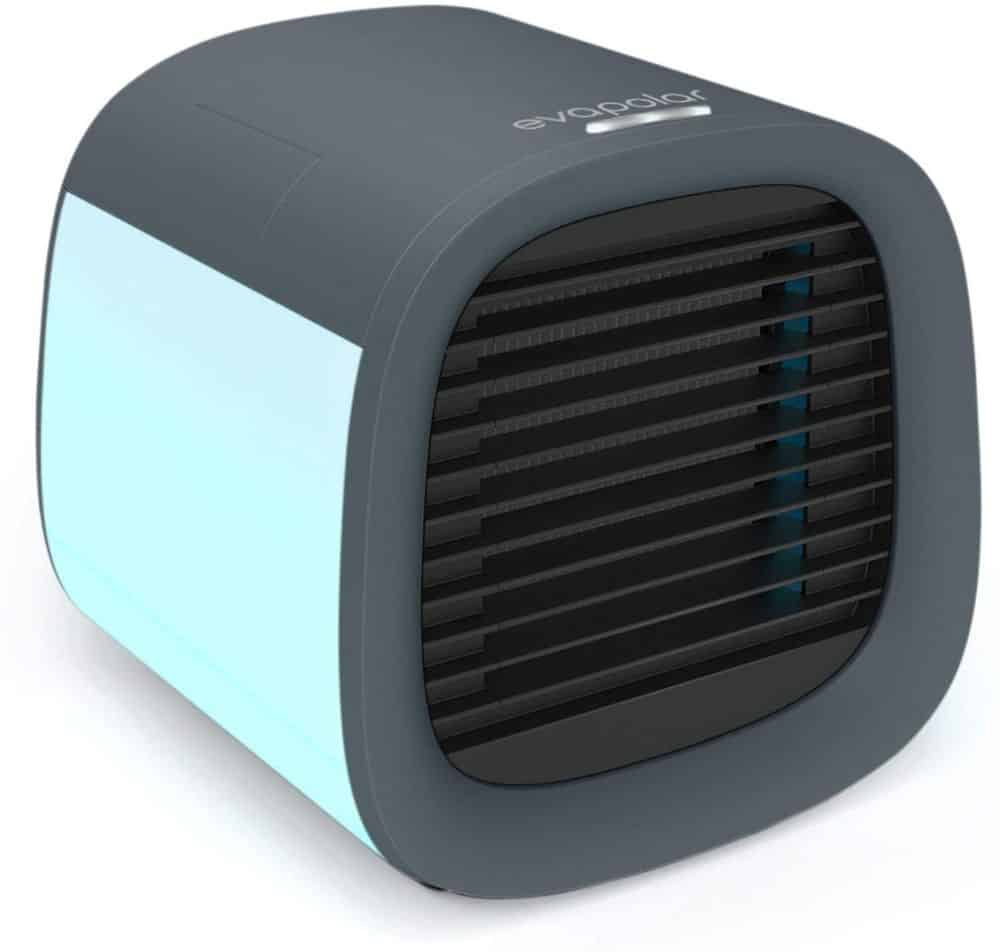
The Evapolar evaCHILL is the most portable and least expensive pick on this list. Its trade-off: it only cools a 45 sq. ft. area directly in front of the unit.
The Evapolar evaCHILL is an evaporative air cooler like our last two picks, so it uses water to cool the air. It’s less powerful, though, only capable of cooling 45 sq. ft. in the area in front of the cooler, so it’s best used in small tents.
Don’t let the cooler’s small size fool you though. The tank is surprisingly large for a cooler of this size and allows the cooler to run for nine hours between refills. You do have to use it with Evapolar’s evaporative pads, but they’re fully biodegradable, so you don’t have to feel bad about creating trash.
The evaCHILL also has a built-in LED light that produces a soft blue light that makes a perfect nightlight.
Note: Please verify this product is currently available on Amazon before purchasing, as listings and model numbers may have changed.
Final Thoughts on the Best Tent Air Conditioner for Camping
Each unit on this list serves a different camper: the hOmeLabs for large family tents with shore power, the Frigidaire for window-port tents, the Honeywell and IcyBreeze for dry climates without hookups, and the evaCHILL for solo campers on a budget. If you camp in a humid area, you’ll want to go with one of our first two picks, which are more traditional style AC units. On the other hand, if you camp in a dryer area, one of the last three is probably the best for you.
For a more affordable way to keep your tent cool, check out some of our other tips on keeping cool in the summer heat, or look into our top picks for the best tent fans. Pair any of these units with the best hot weather camping tents for tents that will also do their part in keeping you cool.
Ready to buy? Click any product link above to check current pricing on Amazon. Prices and availability change frequently, so check back if a unit is out of stock.
Frequently Asked Questions
Can you use an air conditioner in a tent?
Yes. You can use a portable AC, window AC, evaporative cooler, or battery-powered cooler in a tent. The right choice depends on whether your campsite has a 110V power hookup. Traditional portable and window ACs require shore power; evaporative coolers and units like the IcyBreeze can run without it.
How many BTUs do I need for a tent?
A general rule is 20 BTU per square foot of tent floor space. A small 2-person tent (~50 sq. ft.) needs roughly 1,000–2,000 BTU, while a large family cabin tent (~200 sq. ft.) needs at least 5,000 BTU. The hOmeLabs 14,000 BTU unit can handle tents up to 700 sq. ft.
Do tent air conditioners need to be vented?
Traditional portable ACs and window units produce hot exhaust air that must be vented outside the tent — typically through a dedicated AC port or a gap in the tent door. Evaporative coolers do not produce hot exhaust and require no venting, making them simpler to set up in a tent.
Can I run a portable AC off a generator while camping?
Yes, a generator can power a traditional portable or window AC while camping. Make sure your generator’s wattage output exceeds the AC unit’s starting wattage (not just running wattage). Keep in mind that many campgrounds restrict generator hours, so check the rules before relying on one for overnight cooling.


